Effect of a Flare Late Phase on the Earth’s Ionosphere
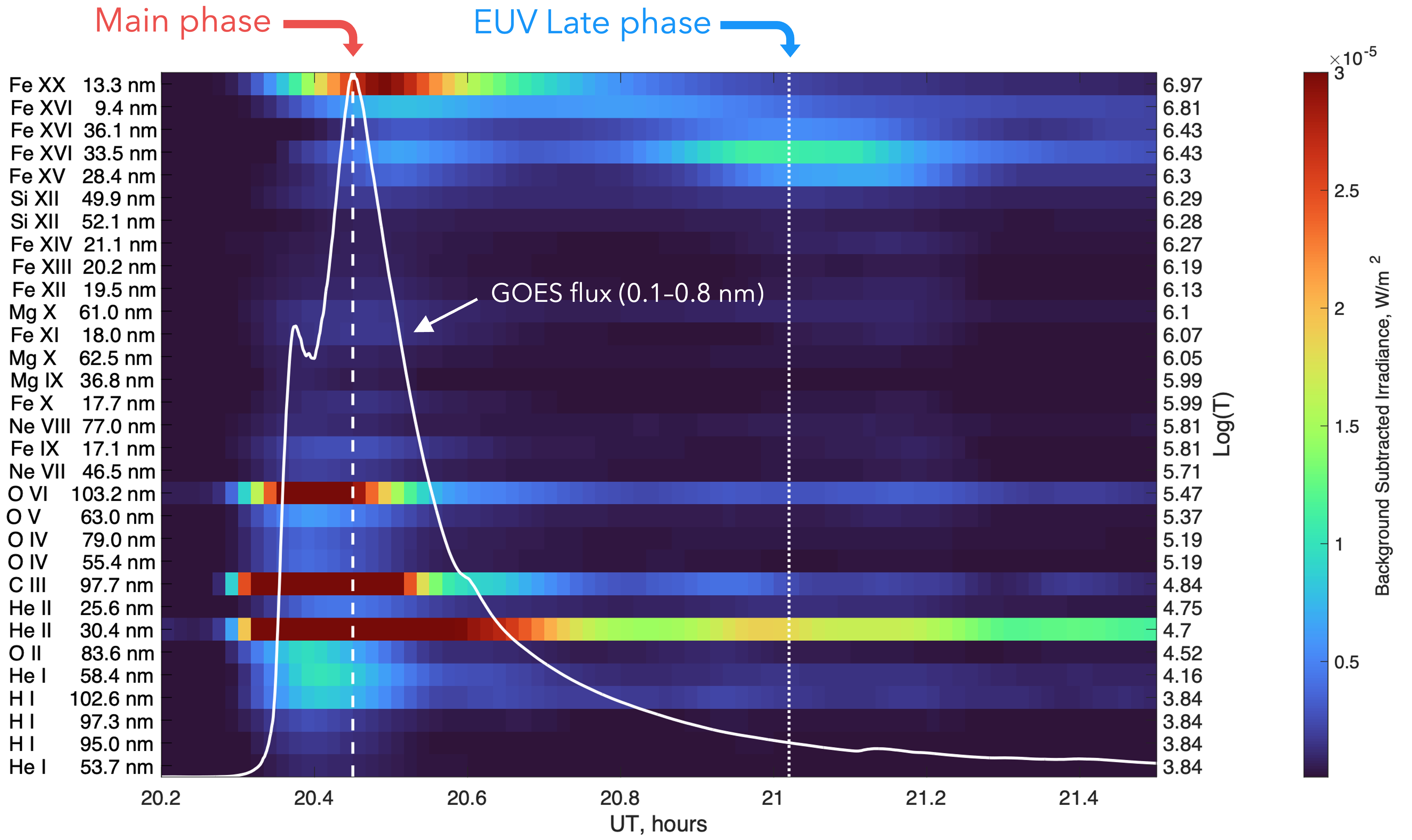
One variant of coronal loop reconnection following the impulsive phase of a flare results in warm coronal emissions (such as Fe XV 28.4 nm and Fe XVI 33.5 nm) exhibiting a second, large emission peak that can lag the primary flare by hours. This secondary peak is known as an extreme-ultraviolet late phase (ELP).
The effect of the late phase on Earth's ionosphere was discovered only in 2024. The associated press release ranked in the top 0.1% of all research outputs tracked by Altmetric, reflecting exceptional interest beyond the academic community.
Below, you can read how our research evolved: from an initial case study to a large-scale statistical analysis.
Publications
-
Case study
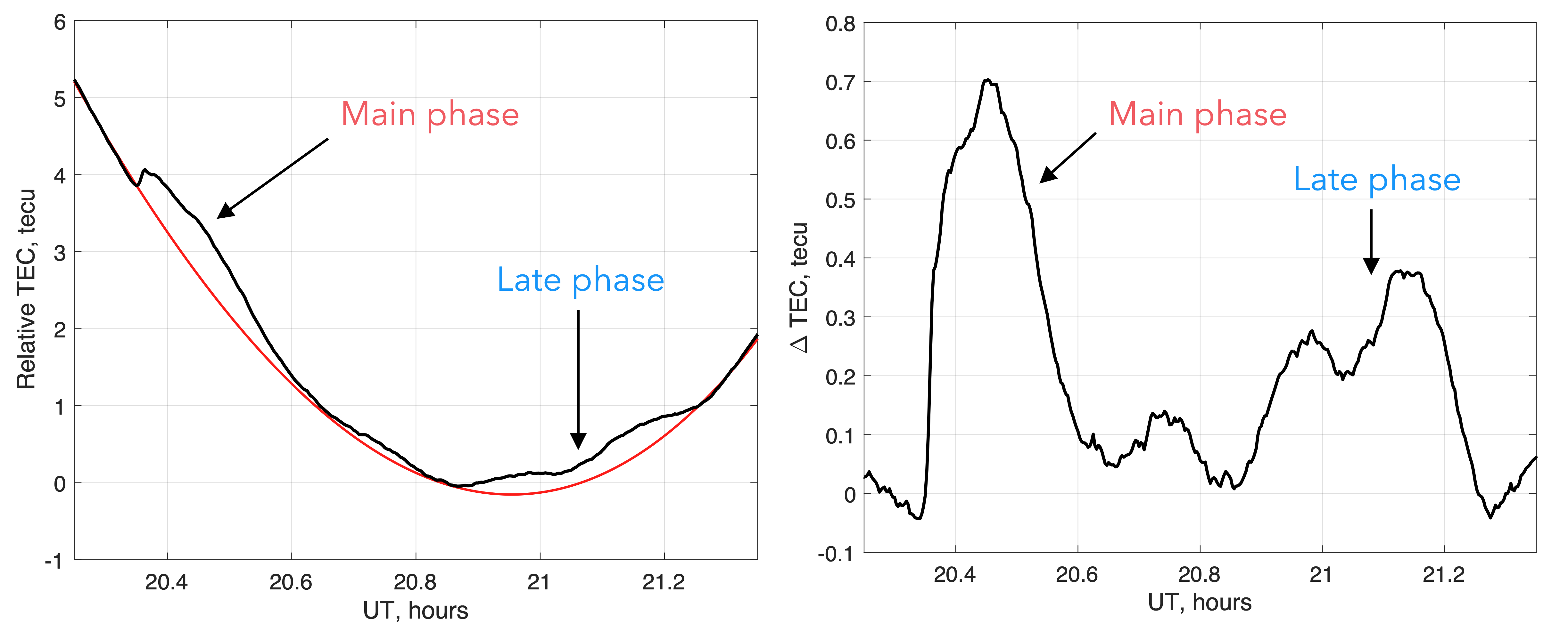
The first report of a late-phase effect on ionospheric Total Electron Content (TEC), based on the flare of 3 November 2011. This article defines the most geoeffective emission of an ELP and provides a numerical estimate of its impact using GNSS data.
-
14 X-class flares
Analysis of the Total Electron Content response to the late phases of 14 X-class flares. Investigation of how solar flare location affects the ratio between the ionospheric response to a flare's main phase and its late phase.
-
Statistical study
Statistical analysis of geoeffective enhancements in Fe XV 28.4 nm emission. Detection of strong late phases following C- and M-class flares. Empirical relationship between irradiance flux increase and TEC response.